

Blue-Zone GmbH
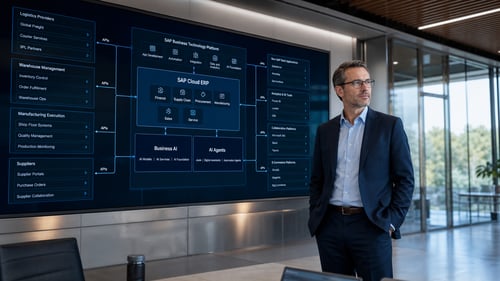
At first glance, it seems that integration with the Autonomous Enterprise has largely been resolved. After all, many integrations are already provided as standard, managed through SAP’s own services, and delivered as “Managed Cloud Integration.” The reality in many companies, however, is quite different. This is because modern SAP landscapes have long since consisted of more than just SAP cloud applications. Hybrid ERP systems, specialized industry solutions, non-SAP SaaS applications, and external partners must continue to communicate reliably with one another, meaning that while integration is constantly evolving, it never completely disappears.
From the Business Suite to the Autonomous Enterprise
For many years, the classic Business Suite was the central system for nearly all business processes. With the transformation to the cloud, SAP is consistently evolving this model. The Autonomous Enterprise combines cloud ERP, specialized line-of-business solutions, Business AI, and data platforms into an integrated enterprise platform.
These include, among others:
- SAP S/4HANA Cloud
- SAP SuccessFactors
- SAP Ariba
- SAP Customer Experience
- SAP Business Technology Platform / Business AI Platform
- Joule and AI Agents
- Preconfigured business processes
- Standardized data models
The goal is clear: Companies should leverage innovations faster, implement extensions in a manner that adheres to standards, and consistently maintain a “clean core .”
Standardized integration reduces effort, but not complexity
With the new SAP Managed Cloud ERP Applications, SAP is increasingly providing preconfigured integrations between cloud ERP and line-of-business solutions . Many integration scenarios are already activated during deployment and no longer need to be developed individually. This is an important step. Companies benefit from faster adoption of new SAP solutions, reduced implementation effort, and more consistent end-to-end processes within the SAP ecosystem.
But this is often where a misunderstanding arises. Standardized integrations make connecting SAP solutions significantly easier than before. However, they do not replace a company’s integration strategy.
The real complexity lies outside the SAP standard
Virtually no company works exclusively with SAP solutions. In nearly every system landscape, there are additional applications and platforms, for example for:
- Logistics
- Production
- Warehouse management
- Transportation management
- E-commerce
- CRM
- Document Management
- IoT
- Specialized Industry Solutions
In addition , there are supplier portals, customer platforms, government portals, and numerous non-SAP SaaS applications. These systems must continue to exchange data, trigger processes, and provide information in real time. So the complexity doesn’t disappear—it simply shifts.
Integration Becomes an Architectural Challenge
In the past, the main challenge was developing individual interfaces. Today, the focus is on connecting entire platform ecosystems with one another. The following topics, among others, play a central role in this :
- API Management
- Event-Driven Architecture
- Business events
- Data harmonization
- Identity Management
- Governance
- Monitoring
- Security
As a result,integration is evolving from a technical discipline into a central component of modern enterprise architectures.
Business AI further increases these requirements
Joule and AI Agents add another dimension. Artificial intelligence can only intelligently support processes if it has access to consistent and up-to-date data. This is precisely why seamless data flows across system boundaries are becoming increasingly important.
A lack of integration not only leads to data silos but also increasingly prevents the productive use of Business AI. Anyone who wants to use AI therefore needs one thing above all else: a clean process and integration architecture.
The Clean Core Doesn’t End at the ERP
Many companies associate the Clean Core approach exclusively with the ERP system. In fact, however, it affects the entire enterprise architecture. A clean ERP core only delivers its full value when extensions, partner solutions, and industry-specific applications are also integrated in a standardized manner .
This requires:
- standardized APIs
- centralized integration platforms
- clear governance
- consistent data models
- reusable integration components
What Companies Should Consider Now
The SAP Autonomous Enterprise significantly reduces the effort required for many standard scenarios. At the same time, however, the demands on the overall architecture are increasing. Companies should therefore not only modernize their core ERP system but also further develop their entire integration strategy. This includes:
- a clear target architecture
- a platform strategy for SAP and non-SAP systems
- API-first instead of point-to-point interfaces
- centralized governance
- end-to-end process analysis
- Preparation for Business AI and AI Agents
Those who lay this foundation can leverage new SAP innovations much more quickly while simultaneously managing the complexity of their system landscape in a sustainable way.
Conclusion: Integration is becoming easier—and at the same time more important
With the SAP Autonomous Enterprise, SAP is on the right track. Preconfigured integrations, standardized processes, and intelligent cloud services reduce implementation effort and accelerate innovation. Nevertheless, integration remains one of the key success factors for modern SAP landscapes. This is because companies will continue to operate in hybrid system environments featuring SAP and non-SAP applications, industry-specific solutions, and a multitude of external partners.
The challenge, therefore, is no longer to develop as many interfaces as possible. It lies in creating an integration architecture that is flexible, scalable, and future-proof. This is precisely the key to unlocking the full potential of the SAP Autonomous Enterprise.