

Blue-Zone GmbH
Why Standard ERP Is Reaching Its Limits
Traditional ERP systems were originally developed to map as many business processes as possible onto a single, centralized platform. This model continues to work very well today for standardized core processes such as :
-
Finance
-
Procurement
-
Inventory Management
-
Master Data Management
However, the more industry-specific processes become, the more frequently functional gaps arise. In industries such as manufacturing, automotive, retail, life sciences, and logistics, generic standard processes are often no longer sufficient. Today , companies need industry-specific processes, integrated compliance functions, real-time data processing, and intelligent, adaptive workflows across the entire value chain.
Added to this is another technological shift: AI is increasingly evolving from a supporting feature to the central control layer of modern business software. AI agents, business AI, and context-based automation are changing the way processes are executed, analyzed, and optimized.
The result: Many companies have heavily customized their ERP systems over the years . The problem with this is well known. Too many customizations often lead to:
-
Complex System Landscapes
-
High Maintenance Costs
-
Difficult Upgrades
-
Slow Innovation
-
Rising Operating Costs
This is precisely where the shift toward Industry Cloud, Business AI, and modular platform approaches comes into play.
Industry Cloud: SAP is moving toward industry-specific solutions
With the SAP Industry Cloud, SAP is pursuing a clear strategic approach: Instead of providing more and more functions directly within the core ERP system, specialized Industry Cloud solutions are being developed outside the actual core ERP.
These solutions specifically address industry-specific requirements and expand the SAP Autonomous Enterprise with intelligent, integrated processes. The focus is particularly on:
- Industry-specific end-to-end Processes
- Data-driven Business Models
- Business AI and AI Agents
- Resilient Supply Chains
- Real-time decision-making Processes
- Flexible Scalability via the SAP Business AI Platform
This is fundamentally changing the architecture of enterprise software. The focus is shifting:
- Away from monolithic ERP
- Toward modular, cloud-based Business Capabilities
At the same time, SAP is working to deliver these solutions more as an integrated business suite. One example of this is the SAP Managed Cloud ERP Applications, which have been available since the February 2026 release. Here, SAP provides preconfigured integrations between cloud ERP solutions and line-of-business applications such as SAP SuccessFactors, which can be activated during deployment. As a result, companies benefit from faster implementation, reduced integration effort, and a more consistent end-to-end process landscape.
For companies, this means one thing above all: business innovations can be introduced much more quickly without changing the core ERP system or building new custom developments.
Vertical SaaS: Why Industry-Specific Software Is Becoming Increasingly Important
At the same time, Vertical SaaS is gaining increasing importance. While traditional SaaS solutions typically address generic processes, Vertical SaaS focuses specifically on individual industries and their unique requirements. The difference is crucial.
A vertical approach already incorporates the following in its standard configuration:
-
Industry-specific Data Models
-
Regulatory Requirements
-
Typical Workflows
-
Integrations into existing Industry Ecosystems
This results in solutions that operate much more closely aligned with companies’ actual business processes. Especially in complex industries, this becomes a decisive competitive advantage. After all , companies today no longer want to develop or customize every function individually . They expect solutions that support their business requirements as precisely as possible right out of the box.
Composable ERP: The Future of Modular Business Software
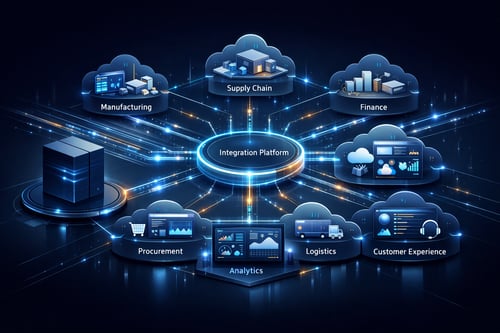
This development has given rise to another key concept: Composable ERP. The idea behind it is relatively simple. Instead of using a single monolithic system for all requirements, companies rely on a modular architecture composed of specialized solutions. While the ERP remains a central component of the system landscape, it is increasingly evolving into a platform and integration hub.
Functions are flexibly added —depending on the industry, process, or business model. A modern composable ERP model therefore often consists of:
- Core ERP system
- Industry cloud solutions
- Specialized SaaS applications
- SAP Business AI Platform Services
- APIs and integration services
- SAP Managed Cloud ERP Applications
- Business Data Platforms
- Analytics and AI Components
- AI Agents and Automation Services
This results in significantly more flexible architectures, and new features can be introduced more quickly without having to modify the entire ERP system. AI agents, in particular, are becoming increasingly important. In the future, they will not only support individual tasks but also orchestrate processes, analyze data contexts, and automate decisions across entire business workflows.
Why Integration Is Becoming a Critical Success Factor
The more modular enterprise software becomes, the more important integration becomes. This is because the actual added value does not come from individual tools, but from the interaction of all systems. This is precisely where many companies currently face a challenge. Whereas in the past as many functions as possible were mapped directly within the ERP system, today we are increasingly seeing distributed system landscapes featuring:
-
Cloud solutions
-
Platform services
-
APIs
-
External partner solutions
-
Industry-specific applications
- AI services and agents
SAP is also increasingly supporting this approach through standardized integration scenarios within the Business Suite. Without a well-defined integration strategy , new data silos and complex process breaks can quickly arise . That is why modern integration platforms and API management are becoming increasingly important. As a result, integration is no longer just an IT issue, but a strategic component of modern enterprise architectures.
Clean Core More Important Than Ever
With the shift toward Industry Cloud and Composable ERP, the way we handle the ERP core itself is also changing. The goal of many companies today is to stay as close to the standard as possible.
As a result, the so-called “Clean Core” approach is gaining massive significance. Instead of developing more and more custom functions directly within the ERP, extensions are increasingly being implemented outside the core —for example , via the SAP Business AI Platform, APIs, Industry Cloud solutions, and specialized SaaS services. This brings decisive advantages:
-
Reduced Complexity
-
Simpler Updates
-
Faster Innovation
-
Better Scalability
-
Faster Adoption of new SAP Features
Clean Core thus becomes the foundation of modern ERP strategies and a prerequisite for efficiently leveraging innovations such as Joule, AI Agents, or new SAP Autonomous Enterprsie Services.
But the path to a modern ERP architecture doesn’t start with technology alone. The key is finding the right combination of standard software, industry-specific solutions, and an integration strategy.
/%3E1920/iStock-2158111727.jpg?width=500&height=333&name=iStock-2158111727.jpg)
What Companies Should Consider Now
Many companies are currently at a critical juncture. The question is no longer whether ERP architectures will change. Rather, the question is how quickly companies can adapt their system landscapes to this new reality. Key success factors include:
- Clear Target Architecture
- A consistent Data Strategy
- Modern Integration Platforms
- API-first mindset
- Modular Scalability
- Focus on Standardization rather than Customization
- Clean Core Strategy
- AI-ready Data and Process Landscapes
Companies that establish these foundations early on can integrate new industry solutions and innovations much more quickly. SAP is also consistently pursuing this approach: Industry Cloud solutions, Cloud ERP, Business AI, and data platforms are increasingly converging in to form an integrated ecosystem . Standardized integrations and preconfigured processes help companies leverage innovations more quickly while ensuring a Clean Core.
Conclusion: The ERP of the future is modular, integrated, and industry-specific
Traditional ERP isn’t going away. But its role is fundamentally changing. Instead of monolithic all-in-one systems, flexible platform architectures are increasingly emerging from:
-
Core ERP Systems
-
Industry Cloud Solutions
-
Vertical SaaS Applications
-
APIs and Integration Services
- Business AI and AI Agents
Composable ERP is not an end in itself. It lays the foundation for continuous business transformation, enabling companies to adapt more quickly to new technologies, industry requirements, and AI innovations. The future , therefore, no longer lies in maximum customization within the ERP system. It lies in modular, integrated, and industry-specific architectures. Companies that embrace Composable ERP and modern integration strategies early on lay the groundwork for faster innovation, better scalability, and long-term sustainability. After all , the key capability of modern enterprise software is no longer just standardization — it lies in adaptability.